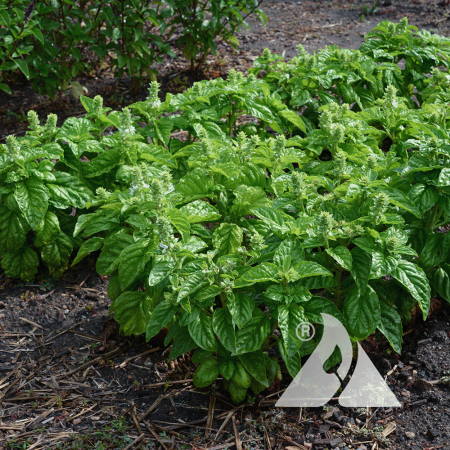
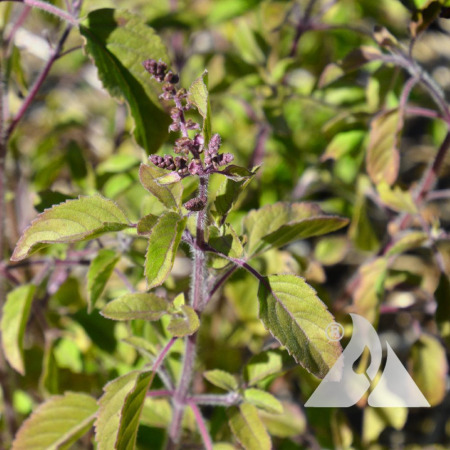
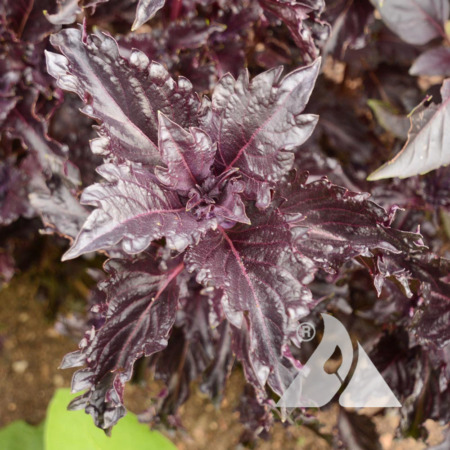
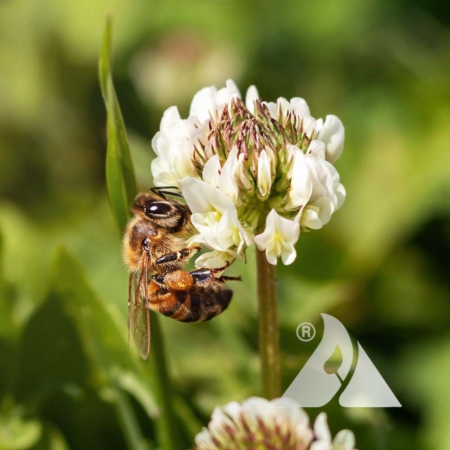
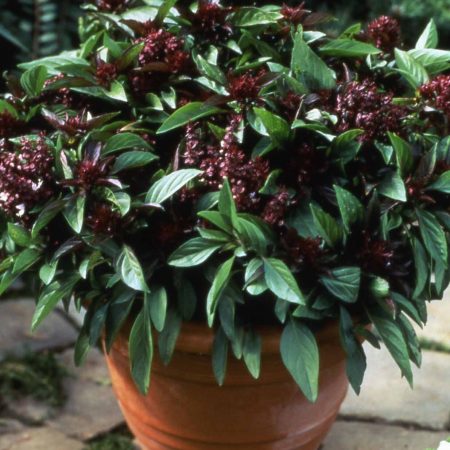
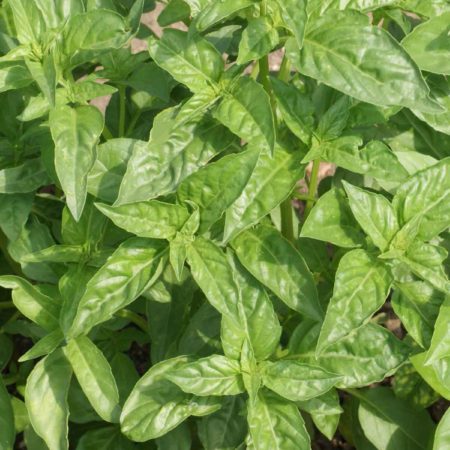
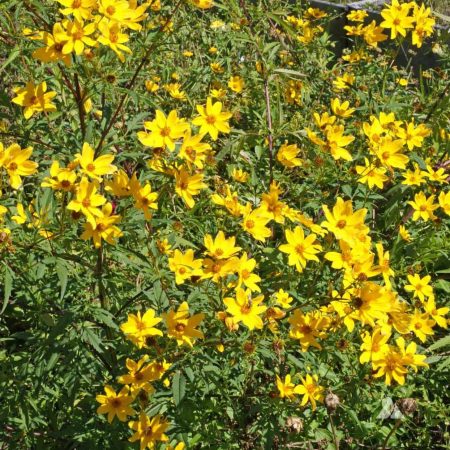
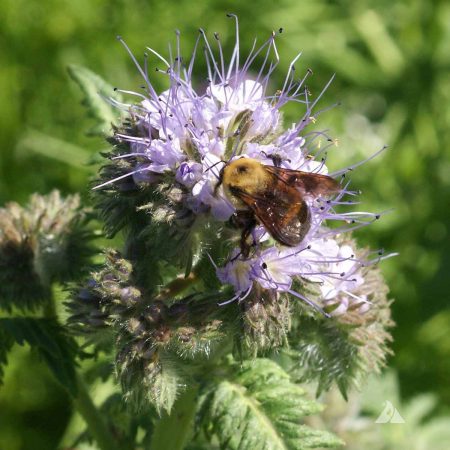
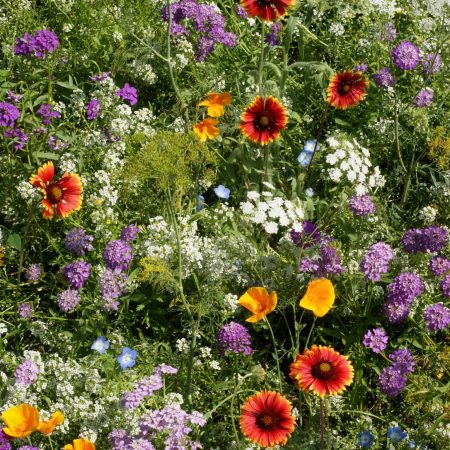
Holy BasilOcimum tenuiflorumCODE: OTHBHoly Basil, or Tulsi, is native to southern Asia where it is known as “The Queen of Herbs”. Holy Basil is an Ayurvedic herb with a long history of medicinal, culinary, and sacred uses. With a more compact habit than culinary basil, the spicy leaves are more commonly cooked than used raw. The flower spikes are dark purple with white flowers, contrasting beautifully with bright green foliage. Sweet Basil ‘Purple Ruffles’Ocimum basilicumCODE: OBPR‘Purple Ruffles’ is both a culinary and ornamental basil featuring a strong sweet-basil flavor with a hint of anise and cinnamon. This striking variety was released in 1984 by breeder Ted Torrey and later became a 1987 All-America Selections winner for both flavor and appearance. The large leaves are a glossy, deep purple with a crinkled texture and jagged fringe. ‘Purple Ruffles’ is uniquely heat tolerant and slow to bolt, with pale pink flowers that provide dramatic contrast with the dark leaves late in the season. This dual-purpose herb is a beautiful addition to kitchen gardens, flower beds, and container gardens. Wallflower, EnglishCheiranthus cheiriCODE: CCHEEnglish Wallflower is native to southern Europe and may have been brought to England by Normans in the 11th century. It is a perennial but can be grown as an annual, and the flower colors include red, orange, yellow, pink, and russet. Best grown where summers are not too hot. Prefers lean, well-drained soils. Clover, WhiteTrifolium repensCODE: TREPWhite Clover is a perennial which can be found growing in lawns and disturbed sites throughout the U.S. Flowers bloom from the bottom to the top of the flower cluster. Excellent for wildlife and pollinator plantings as well as flowering lawn mixtures. Grows in average, medium, well-drained soils, ideally moist soils in light shade but will adapt to dry soils in full sun. Flowers attract honey bees, bumble bees and other pollinators. Fulfills legume requirement for NRCS-CRP pollinator practices. Aster, FalseBoltonia asteroidesCODE: BOASFalse Aster, also known as Eastern Doll’s Daisy or White Doll’s Daisy, is a perennial from the eastern half of the U.S. and Canada. Plants have sturdy stems, narrow gray-green leaves and produce beautiful sprays of numerous white flowers in late summer and fall. Plants spread by rhizomes but do not spread aggressively. This species typically occurs in sunny to lightly shaded forests, thickets, stream banks, moist meadows and prairies. Plants endure seasonal flooding and tolerate standing water for short periods. Flowers are attractive to many pollinators such as bees, beetles, butterflies, flies, moths and skippers. Plants also attract beneficial insects that prey upon pest insects. Recommended for pollinator gardens, wet meadows, detention basins, and rain gardens. Mountain Mint, VirginiaPycnanthemum virginianumCODE: PYVIVirginia Mountain Mint is a perennial that is native to the northeastern and midwestern U.S. and is typically found in moister soils of meadows, prairies, and open woods. The leaves, when crushed, have a strong, minty scent, and the small, white flowers occur in clusters at the top of the branches. Because it is long-blooming, it is an excellent choice for pollinator conservation. The flowers have many insect visitors and are especially attractive to honey bees and short-tongued native bees as well as beneficial wasps. Plants are deer-resistant. Sweet Basil ‘Siam Queen’Ocimum basilicumCODE: OBSQSweet Basil ‘Siam Queen’ is a lovely basil that produces dark purple flowers on sturdy plants. The leaves are extra large and have a very strong, clove-like scent. Siam Queen was a AAS winner in 1997. It is very popular in Thailand and is known as Thai basil. Basil is a tender annual that comes from the Old World tropics. It prefers sunny locations and rich soil. Appreciates afternoon shade in hot, southern climates. Can be grown in containers indoors as well as outside. Culinary uses: Mediterranean, Thai and southeastern Asian cuisine; curries, fish and beef dishes. Contact us for pricing. Sweet Basil ‘Italian Large Leaf’Ocimum basilicumCODE: OBILSweet Basil ‘Italian Large Leaf’ is a tender annual that comes from the Old World tropics. It prefers sunny locations and rich soil. Appreciates afternoon shade in hot, southern climates. Can be grown in containers indoors as well as outside. Flowers are very attractive to honey bees. Basils have a clove-like scent and taste. Our Italian Large Leaf has a milder and more citrusy taste than our Genovese Type. Culinary uses: Mediterranean cuisine; tomato-based sauces, soups, salads, pasta, pesto, chicken, fish seafood, vegetables and vinegars. Sunflower, TickseedBidens aristosaCODE: BIARTickseed Sunflower is an annual wildflower that also goes by the name of Swamp Marigold because of its preference for moister environments such as wet meadows. It is native to the eastern half of the United States as well as Ontario, Canada. Flowers attract beneficial insects and provide food for native bees and honey bees. Beneficial Bug Seed MixtureCODE: BUGMXThe flowers in the Beneficial Bug Seed Mixture attract beneficial insects to the garden. Beneficial insects include lacewings, lady beetles, hover flies, syrphid flies and parasitic wasps. These beneficial insects help to destroy harmful garden pests such as aphids, thrips and mites. 8 ounces or more may be purchased at the pound price. Sweet Alyssum, Dwarf PinkLobularia maritimaCODE: LPNKDwarf Pink Sweet Alyssum is a favorite of gardeners, prized for its masses of fragrant flowers and used as an edging plant or addition to the border. Plants bloom quickly from seed. Plants tolerate a range of growing conditions and are easily grown. ‘Dwarf Pink’ makes an excellent edging plant as it grows only 2-4 inches tall. Sweet Alyssum, Dwarf ‘Royal Carpet’Lobularia maritimaCODE: LROYDwarf Sweet Alyssum ‘Royal Carpet’ is an heirloom variety that was an AAS winner in 1953. ‘Royal Carpet’ has purple flowers and is very dwarf, growing to only 2-4 inches tall. It blooms quickly from seed, is easy to grow and makes a great addition as an edging plant in the border. Sweet Alyssum, Dwarf ‘Carpet of Snow’Lobularia maritimaCODE: LCPTDwarf Sweet Alyssum ‘Carpet of Snow’ is a compact variety that produces masses of white, fragrant flowers on plants that grow to only 4 to 6 inches tall. Plants are great for borders and attracting beneficial insects. Sweet Alyssum is tolerant of a wide range of growing conditions. Sweet Alyssum, Tall WhiteLobularia maritimaCODE: LMARTall White Sweet Alyssum flowers are sweetly fragrant and excellent for attracting beneficial insects. Plants are highly adaptable and bloom all year round in warm climates. They bloom quickly from seeding and grow to 16 inches tall. Candytuft, AnnualIberis umbellataCODE: IUMBAnnual Candytuft blooms in just 55 days from seeding. This slender/mounded annual produces dense clusters of small, white, pink or purple flowers. It prefers full to partial sun and dry to moderate moisture. Plants are intolerant of damp soil conditions or shade. Candytuft, Rocket ‘Empress’Iberis amaraCODE: IBAMRocket Candytuft ‘Empress’ is a fast-growing annual and excellent ornamental for use in beds, borders and on sunny slopes. The plants produce fragrant white flowers and are easily grown in average to poor, well-drained soil and prefers full sun to partial sun. Globe GiliaGilia capitataCODE: GCAPA drought tolerant annual growing from British Columbia to central California and east to Idaho, Globe Gilia is an adaptable plant with blue flowers, tolerating full to part sun and dry to moderate moisture. Honey bees, wild bees and other pollinators are attracted to its nectar. Prairie Clover, PurpleDalea purpureaCODE: PPURPurple Prairie Clover is a native perennial that is found throughout the high plains and central U.S. Flowers bloom from the bottom to the top of the flower cluster. Excellent for wildlife and pollinator plantings. Flowers attract honey bees, bumble bees and other pollinators. Fulfills legume requirement for NRCS-CRP pollinator practices. Prairie Clover, WhiteDalea candidaCODE: PECAWhite Prairie Clover is a native perennial which can be found throughout the high plains and central U.S. Flowers bloom from the bottom to the top of the flower cluster. Excellent for wildlife and pollinator plantings. Flowers attract honey bees, bumble bees and other pollinators. Fulfills legume requirement for NRCS-CRP pollinator practices. Coreopsis, Lance-LeavedCoreopsis lanceolataCODE: CLANThis yellow perennial is native to the eastern and midwestern U.S. The long-blooming plants grow to 36 inches tall. Suitable for cutting, beds and borders, wildflower mixtures, and pollinator gardens. Flowers attract beneficial insects and will feed honey bees and wild bees. Tolerant of dry to moist soils and recommended for rain gardens and bioswales. Daisy, CreepingChrysanthemum paludosumCODE: CPALCreeping Daisy is a white annual flower from the Mediterranean region. Plants grow to just 12 inches tall. Suitable for low-growing flower mixtures and border edges. Attracts beneficial insects. Daisy, Shasta ‘Silver Princess’Chrysanthemum maximumCODE: CMADShasta Daisy ‘Silver Princess’ is a charming cultivar with 3 inch wide flowers that have white petals and a yellow center. Plants grow to just 16 inches tall. Excellent for the front of borders and rock gardens. Attracts beneficial insects to the garden. Remove spent flowers to promote longer bloom. Plants are somewhat short-lived. Daisy, Shasta ‘Alaska’Chrysanthemum maximumCODE: CMAXShasta Daisy ‘Alaska’ is an old-fashioned variety that is perfect for cut flowers and cottage gardens. The 3 inch wide flowers have white petals and a yellow center. Plants grow to 30 inches tall. Attracts beneficial insects to the garden. Remove spent flowers to promote longer bloom. Plants are somewhat short-lived. Wallflower, SiberianCheiranthus allioniiCODE: CALLSiberian Wallflower is native to Europe. Flowers are vivid orange and are fragrant and adaptable. Use in fragrant flower mixtures, beds and borders, and the pollinator garden. Bishop’s FlowerAmmi majusCODE: AMAJBishop’s Flower is also known as False Queen Anne’s Lace or Laceflower. Plants produce white flower clusters up to 6 inches across. They will grow to 30 inches tall and have finely divided leaves. The flower stalks are wonderful for cutting or drying. The flowers are attractive to beneficial insects, and songbirds love to eat the seeds. Basket-of-GoldAlyssum saxatileCODE: ASAXBasket-of-Gold is an old-fashioned perennial from Europe and adds sunny color to the garden in springtime. Plants grow in low mounds of 8-12 inches tall, and flowers are bright yellow with 4 petals. It is right at home in the rock garden or along border edges. It prefers sunny locations and drier soils. Plants are evergreen and provide winter interest. Yarrow, WesternAchillea millefolium occidentalisCODE: ACLAWestern Yarrow is native to the western U.S. and is often used in reclamation and restoration projects in dryland areas. Plants have finely divided, fern-like leaves, woolly hairs and a pungent scent. The flowers are white and occur in flat-topped clusters. Plants are very drought tolerant. Yarrow, RedAchillea millefolium rubraCODE: ARUBRed Yarrow has finely divided, fern-like leaves and a pungent scent. Flowers are dark pink to deep carmine and occur in flat-topped flower clusters. Attracts beneficial insects. This species has rhizomes and can spread aggressively in home gardens or where soils are moist. To contain rhizomes, grow plants in 5 or 10 gallon plastic pots that have been partially buried in the ground. Yarrow, WhiteAchillea millefoliumCODE: AMILWhite Yarrow as finely divided, fern-like leaves and a pungent scent. Flowers are white and occur in flat-topped flower clusters. This species has rhizomes and can spread aggressively in home gardens or where soils are moist. It is best used in dry areas where soil stabilization is needed, or as an aggressive ground cover to help choke out weeds. Mature plants can be mowed on a high setting. Flowers attract beneficial insects. CatnipNepeta catariaCODE: NCATCatnip is a member of the mint family and is a hardy perennial that has a distinctive fragrance that is intensely attractive to most cats. It is native to Europe, the Middle East and Asia. The small, white flowers are attractive to honey bees and wild bees. Grows best in full sunlight and average, well-drained soils. Drought tolerant and deer resistant. The essential oil has mosquito repellent qualities, and can deter aphids and squash bugs in the garden. Catnip can reseed aggressively – cut off spent flower stalks before they drop seed. Contact us for pricing. DillAnethum graveolensCODE: AGRADill is an annual that has been used as a medicinal and culinary herb for millennia. Both seeds and leaves are utilized and have a soft, sweet flavor. Leaves are finely divided and feathery looking, and when they are cut and dried are referred to as dill weed. Dill weed has a more mellow flavor than dill seeds. The yellow flowers occur in umbels and can be used for cutting. Certain swallowtail butterflies will use Dill as a host plant. Culinary uses: garnish, eggs, potatoes, pasta salads, fish, seafood, pickling, salad dressings and sauces. Popular in German, Russian and Scandinavian cuisines. Contact us for pricing. CilantroCoriandrum sativumCODE: CSATThis annual herb is a member of the carrot family and has two different uses as a culinary herb. The young leaves are used as cilantro while the dried seeds are known as coriander. Plants bolt quickly – staggered plantings extend availability during the growing season. Culinary uses for Cilantro: Mexican, Mediterranean and Asian dishes; garnish, guacamole, chicken, beans, pork, rice, salsas, sauces, fish and shellfish. Culinary uses for Coriander: Indian, Mediterranean, Middle Eastern, and Asian dishes; curries, curry powder, pickling, sausages, sauces, soups and stews. FennelFoeniculum vulgareCODE: FVULThis perennial herb is a member of the carrot family and originally comes from the Mediterranean. Plants are hardy to USDA zone 6 – grow as an annual in colder climates. Fennel has an anise-like flavor, and the leaves, bulbs and seeds can be utilized for cooking. Plants and flowers are attractive to butterflies, ladybugs, lacewings and pollinators. Fennel is a host plant to various swallowtail butterflies. Culinary uses: dressings, eggs, fish, seafood, pasta, soups, sausages, and tea. In India and Pakistan, fennel seeds are used as a breath freshener and after-meal digestive. Contact us for pricing. Golden AlexanderZizia aureaCODE: ZIAUGolden Alexander is a perennial that is native to the eastern and Midwestern U.S. and can be found in moist woods, prairies and meadows. It resembles Queen Anne’s Lace but has yellow flowers. Plants bloom in spring and attracts butterflies, small pollinators, and other beneficial insects. Host plant for the Missouri Woodland Swallowtail and Black Swallowtail butterflies. Makes a good cut flower.